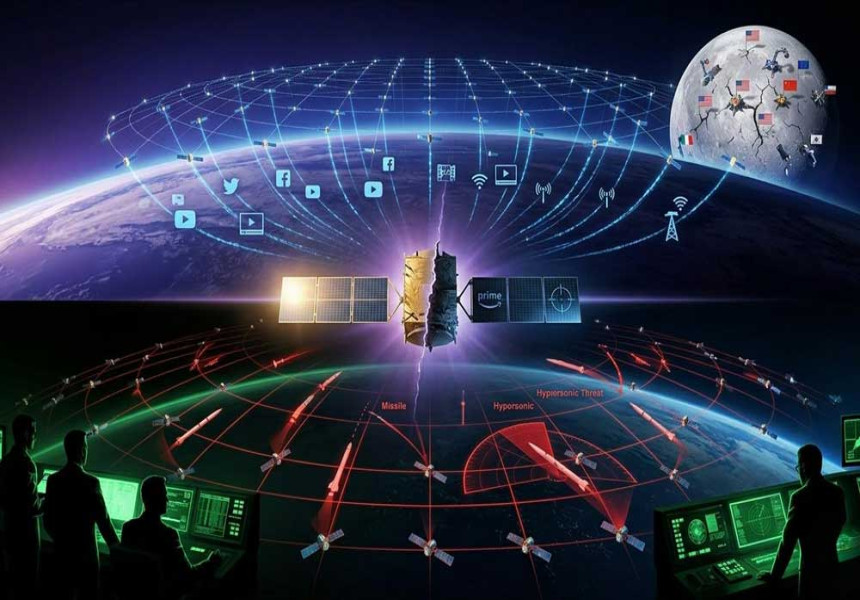
Space-Based Data Centers: Could They Power Future U.S. Military Missions?
Recent proposals to place data centers in orbit are gaining traction in both commercial and military sectors, with potentially transformative implications for American defense operations.
The Context and Military Vision
According to James O'Brien, head of global satellite communications at U.S. Space Command, orbital data centers represent the natural evolution of space proliferation.
The primary goal is to reduce data latency — the time required to transmit information between sensors, decision centers, and intervention systems — a critical factor for missions requiring real-time responses.
The immediate context is the Golden Dome for America initiative from the Trump administration, aiming to implement a layered national missile defense architecture by 2029.
O'Brien stated clearly: "I can't imagine it [the Golden Dome] without [space computing]" . The threat of maneuverable hypersonic missiles developed by China and Russia makes data processing as close to the source as possible — space-based edge computing — indispensable.
Tech companies are already moving in this direction: Google unveiled Project Suncatcher in November 2025, with test satellite launches planned for 2027; SpaceX announced plans for a constellation of one million satellites functioning as an orbital data center; NVIDIA, Blue Origin, OpenAI, and the startup StarCloud are exploring similar concepts.
Strategic Advantages for the Armed Forces
- Drastic latency reduction: For satellites in geostationary orbit (GEO), the distance from Earth introduces significant delays. Processing data directly in orbit eliminates the need to transmit it to Earth and back.
- Tactical edge computing: Distributing decision-making processes instead of centralizing them in ground facilities increases resilience and response speed.
- Spectrum efficiency: Reduced congestion of radio frequencies needed for data transmission to Earth.
- Commercial-military dual-use: Orbital commercial data centers could simultaneously serve civilian and military needs, as already happens with satellite communications.
Problems and Challenges
Despite the enthusiasm, experts highlight considerable obstacles:
1. Costs and Economic Sustainability
Launching and maintaining infrastructure in orbit is "insanely expensive" . Even for satellite edge computing — which is far more limited than a true AI data center — cost-effectiveness compared to terrestrial solutions has not yet been demonstrated.
2. Radiation and Hardware Reliability
The space environment exposes hardware to ionizing radiation that can damage electronic components. Repairs are practically impossible, making radiation-hardened system design and redundancy critical.
3. The Difference Between Edge Computing and AI Data Centers
An important distinction emerges from the technical literature: while space-based edge computing (filtering and analyzing satellite data in orbit before sending it to Earth) is technically feasible and already in development , true orbital AI data centers for model training represent a challenge of entirely different magnitude. Training AI models requires computing power, energy, and cooling on a completely different scale compared to edge processing.
4. Energy Consumption and Cooling
Although there are no water consumption issues for cooling in orbit (one of the main criticisms of terrestrial data centers ), energy generation and management in space present unique challenges. Solar panels must compete with launch weight and volume constraints.
5. Security and Vulnerability
Data centers — terrestrial or space-based — have become strategic targets in modern warfare. In March 2026, Iranian drones struck three AWS data centers in the United Arab Emirates and Bahrain . An orbital data center, while more difficult to reach kinetically, could be vulnerable to cyber threats or anti-satellite weapons.
6. Supporting Infrastructure
The Space Force has requested $1 billion for fiscal 2027 to build four space operations centers across the country , highlighting that even with data centers in orbit, substantial ground-based supporting infrastructure will still be necessary.
Final Thoughts
Space-based data centers represent a fascinating prospect for U.S. military missions, particularly for missile defense architectures like Golden Dome that require zero-latency data processing.
However, the path to realization is long: the gap between feasible satellite edge computing and true orbital AI data centers is enormous, and the challenges of costs, radiation, energy, and security are not negligible. As one expert observed, space data centers will not soon replace terrestrial ones, but could integrate them in mission-critical niches where latency is unacceptable
Share This
Leave a Comment