Doubao: How ByteDance Built the AI Infrastructure China Actually Uses
The Product: Not a Chatbot, an Operating System
Doubao (豆包, "soybean pod") is ByteDance's AI assistant. Launched August 2023. 227 million monthly active users as of December 2025. Fourth-largest generative AI app globally. But these numbers miss the point.
Doubao isn't competing with ChatGPT. It's competing with the friction of digital life itself.
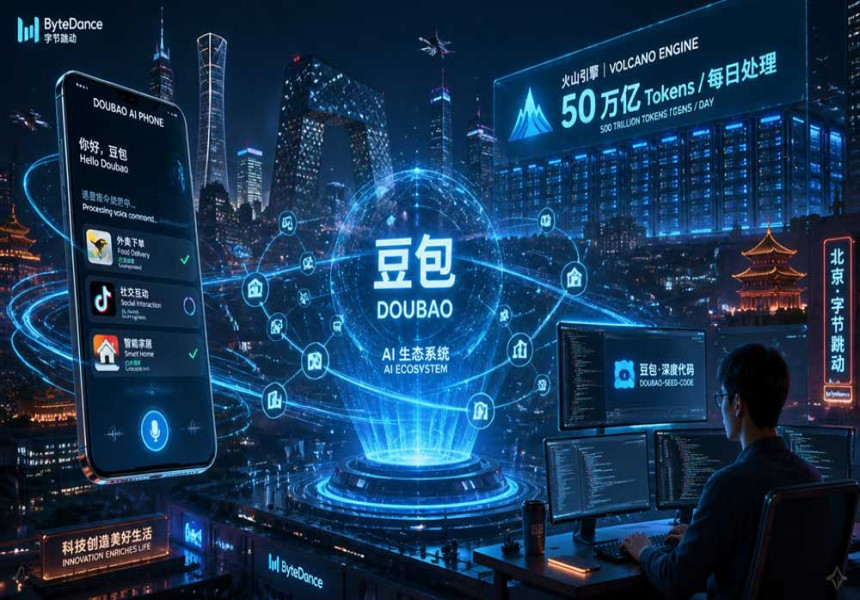
While Western AI companies optimize for benchmark scores, ByteDance optimized for integration density—how many times per day a user can offload a task to Doubao without thinking about it. The result? 100+ million daily active users and processing 50 trillion tokens daily through Volcano Engine, its cloud backbone.
The Hardware Play: Your Phone Is Now the Agent
In December 2025, ByteDance and ZTE launched the Nubia M153 Doubao AI Phone (~$495). This wasn't a licensing deal. It was an architecture decision.
The phone runs Doubao at system level. Not as an app. As the interface layer.
- - "Doubao, Doubao, order my usual from that Sichuan place" → food ordered, payment authenticated, delivery tracked. Zero screen touches.
- - Cross-app automation: Like every video from a Bilibili creator. Book a train ticket. Schedule a meeting across three different apps. The agent executes, the user delegates.
- - Persistent memory: It learns. Preferred restaurants, commute patterns, communication styles. The phone becomes context, not just hardware.
30,000 units. Sold out in seconds. Secondary market prices exceeded retail.
This is the AI-native device Apple and Google are still slide-decking.
The Model Stack: Four Tools, One Job
February 2026: Doubao 2.0. ByteDance stopped calling it a chatbot release. They called it the "Agent Era".
The suite is segmented by economic function, not just capability:
Doubao 2.0 Pro handles the heavy lifting. Deep reasoning, long-context chains, competitive with GPT-5.2 and Gemini 3 Pro on complex tasks. This is the premium tier for professionals who need reliability over cost.
Doubao 2.0 Lite is the workhorse. Better than the previous generation, optimized for the performance-cost ratio that makes mass deployment viable. This runs most consumer-facing interactions.
Doubao 2.0 Mini is the infrastructure layer. Low latency, high throughput, minimal cost. When Doubao processes those 50 trillion daily tokens, Mini is doing the bulk of the work.
Doubao-Seed-Code is the developer bet. 256K context window, state-of-the-art on SWE-Bench, priced at $0.17 per million input tokens. Claude Opus 4.5? $5.00. That's not undercutting. That's redefining the unit economics of AI-powered development.
ByteDance isn't just selling models. They're pricing AI agents into viability.
The Ecosystem: Why DeepSeek Has the Headlines, Doubao Has the Users
DeepSeek (~136M MAU) proved China could build world-class open-source models. Respect earned. But ~40% of DeepSeek users are migrating to Doubao.
Why? Three vectors:
- - Distribution: Douyin (Chinese TikTok) has 700M+ users. Doubao is one tap away. DeepSeek requires intent. Doubao requires habit.
- - Integration: Volcano Engine holds 49.2% market share in Chinese AI cloud services. Doubao isn't an API call. It's the default.
- - Execution: During Spring Festival Gala 2026, Doubao handled 1.9 billion interactions in one night. No degradation. No viral failure. Infrastructure at scale.
DeepSeek won the GitHub stars. Doubao won the infrastructure contract.
The International Question: Dola and the Feature Gap
Abroad, Doubao operates as Dola (formerly Cici). 10M+ DAU by end of 2025. But it's a diluted product—partial third-party models, limited multimodal depth, none of the ecosystem hooks that make the Chinese version sticky.
This isn't oversight. It's strategic sequencing. ByteDance is securing the home market first, where regulatory alignment and platform control are advantages. International expansion follows when the model economics and geopolitical climate align.
The Money: $23 Billion for Invisible Infrastructure
ByteDance's 2026 AI investment: ~$23 billion. Up from $21B in 2025. Roughly half directed at silicon—potentially 20,000 Nvidia H200 units, plus domestic chip partnerships.
But the critical allocation isn't hardware. It's agent infrastructure: the systems that let Doubao execute across apps, remember context, and operate autonomously without human-in-the-loop for every step.
The bet isn't "build a better LLM." It's "own the layer between user intent and digital action."
The Future: From Chatbot to Economic Layer
Doubao's roadmap isn't feature-driven. It's role-driven:
- - Complex execution: Travel booking, procurement, workflow orchestration—fully delegated
- - IoT expansion: Smart glasses, earbuds, home systems. The phone is just the first node
- - AI Phone 2.0: Already announced, suggesting annual hardware iteration tied to model releases
The end state isn't an assistant you query. It's an invisible economic layer that mediates between user desire and digital fulfillment.
The Strategic Take
Western AI discourse focuses on model capability—parameters, benchmarks, reasoning chains. ByteDance focuses on integration surface area: how many touchpoints can Doubao absorb?
This is the difference between AI as tool and AI as infrastructure.
Doubao isn't winning because it's smarter. It's winning because it's everywhere, cheap, and executing tasks rather than generating text.
The question for Western markets isn't whether Doubao arrives. It's whether the infrastructure to compete—ecosystem control, hardware integration, aggressive unit economics—can be built before the paradigm shifts irreversibly.
Share This
Leave a Comment