
Are "Free" AI Agents Like OpenClaw Actually Trojan Horses? A Security Leader's Perspective
The pitch is compelling: install an open AI agent, connect it to your stack, and watch it automate workflows, manage communications, and execute tasks on your behalf. The narrative promises control. The architecture demands delegation.
As security leaders, our job isn’t to chase automation at all costs—it’s to ask who holds the keys when the agent starts working.
Independent evaluations of OpenClaw and its ecosystem variant QClaw reveal a stark reality: these tools operate with deep system privileges, zero third-party security certifications, and documented pathways for credential theft and data exfiltration. If the service is free, you aren’t just the user. You’re the attack surface.
The Illusion of Control: “I Installed It, So I Govern It”
Open-source and community-driven AI agents market themselves as transparent, self-hosted, and user-controlled. But functionality requires access. To execute tasks, an agent needs:
- -File system traversal
- -Shell/command execution
- -Environment variable injection
- -API token management
- -Browser session control
- -Third-party service integration
This isn’t a flaw. It’s a requirement.
The problem emerges when we conflate installation with governance. Granting persistent, privileged access to an uncertified process doesn’t give you control. It transfers digital sovereignty. And when sovereignty is delegated without contractual boundaries, accountability becomes undefined. In enterprise security, we don’t measure trust by promises. We measure it by architecture, auditability, and enforceable limits.
The Data Doesn’t Lie: Documented Exposure, Not Theoretical Risk
Independent security assessments and penetration testing frameworks have moved past speculation. The metrics are clear:
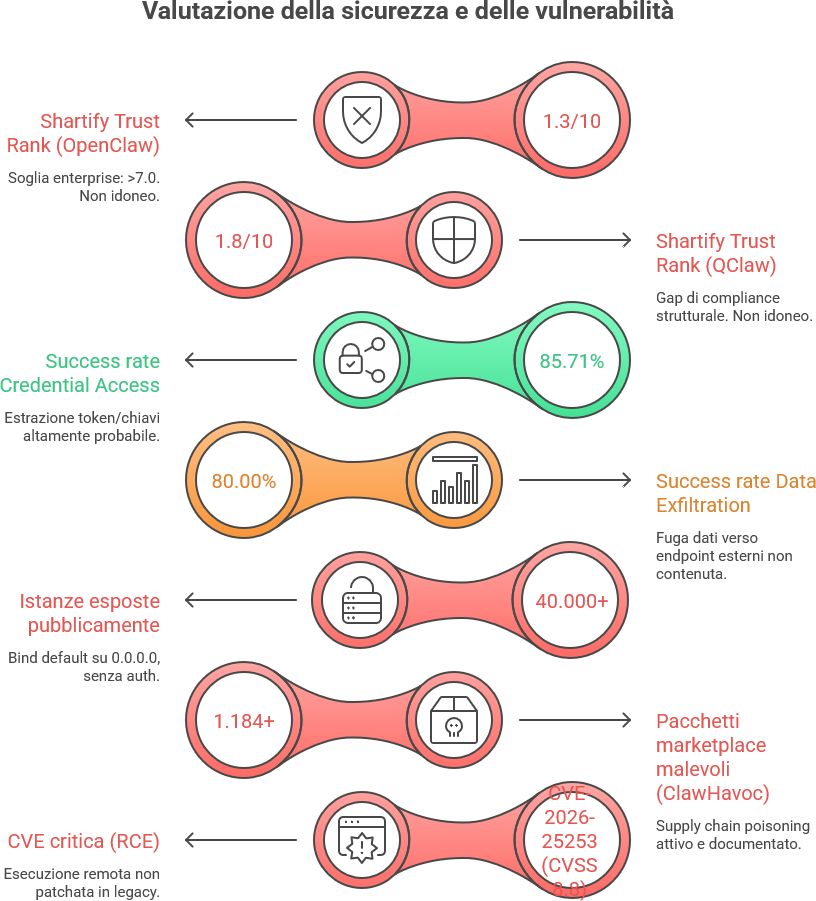
These aren’t edge cases. They are active, repeatable attack vectors. The Dutch Data Protection Authority (AP) has already issued formal advisories against using OpenClaw for sensitive data processing. Security leaders don’t need to guess the risk. It’s been measured, documented, and independently validated.
The Modern Trojan Horse: Consent, Not Compromise
Traditional malware forces entry. Modern AI threats don’t need to. They enter with explicit permission, operate under legitimate credentials, and embed themselves into daily workflows.
The danger isn’t necessarily malicious intent at deployment. It’s latent intent. A modern trojan doesn’t need to be harmful on day zero. It only needs to become so after:
- - A software update
- - A revised telemetry or data-handling policy
- - A corporate acquisition or governance shift
- - A pivot toward commercial data monetization
QClaw, backed by Tencent, already routes traffic through Singapore and US data centers. OpenClaw’s original creator has transitioned to OpenAI. The code remains. Governance shifts. Privileges persist.
In enterprise security, we assess tools by their attack surface, update lifecycle, and contractual boundaries. By those metrics, these agents operate in a structural gray zone.
The Compliance Blind Spot: Where Your Data Actually Goes
Connect an agent to email, CRM, cloud storage, or financial APIs, and it begins processing data. But who guarantees that:
- - Inputs aren’t logged, aggregated, or repurposed for model training?
- - Traffic doesn’t route through unvetted endpoints without residency controls?
- - Hidden telemetry isn’t mapping usage patterns for commercial profiling?
OpenClaw and QClaw publish zero Data Processing Agreements (DPAs). They offer no certified mechanisms for GDPR consent, data portability, or right to erasure. Data residency is non-configurable. Logs are local, mutable, and incompatible with enterprise SIEM standards.
In legal terms: you are transferring data to an unidentified processor, without contract, without audit, without guarantee. If that data is later licensed, profiled, or used to train a proprietary model, you have no legal footing to object. “Open-source” does not equal “privacy-by-design.” Voluntary installation does not equal informed consent under data protection law.
What Security Leaders Must Do Now
We can’t pause innovation, but we can enforce boundaries. If your organization is evaluating or already deploying agent-based automation, implement these controls immediately:
- 1. Isolate Execution Environments
Run agents in air-gapped or strictly network-segmented containers. Block internet access unless explicitly required, logged, and justified. - 2. Externalize Credential Management
Never store raw API keys or OAuth tokens in .env files. Use HashiCorp Vault, AWS Secrets Manager, or enterprise-grade credential brokering with just-in-time access and automatic rotation. - 3. Enforce Strict Least Privilege
Default to tools.profile: "minimal". Explicitly block filesystem, terminal, and network access. Whitelist only what’s operationally necessary. Assume breach, verify access. - 4. Audit Every Update as a Policy Change
Treat version bumps as potential shifts in data handling or telemetry. Review code diffs. Don’t trust changelogs. Log and approve deployments through your change management process. - 5. Migrate to Certified Platforms for Production/GDPR Use
If you process user data, operate in regulated industries, or require auditability, choose platforms with SOC 2 Type II, signed DPAs, immutable audit trails, and legally binding SLAs. Automation without accountability isn’t efficiency. It’s exposure.
The Bottom Line for Security Leadership
AI agents aren’t inherently malicious. But privilege without verification is a structural risk. OpenClaw and QClaw demonstrate how quickly “free automation” can become an unverified, highly privileged process operating inside your perimeter.
As security leaders, our mandate isn’t to block innovation—it’s to ensure that every tool we deploy aligns with our risk posture, compliance obligations, and duty of care. The question isn’t whether AI agents will transform how we work. It’s whether we’ll govern them before they govern us.
🔍 Have you evaluated the trust posture of your AI tooling? What controls are non-negotiable for your security program? Share your perspective below.
Share This
Leave a Comment